Get Professional GeM Portal Consultancy Services
Contact Form
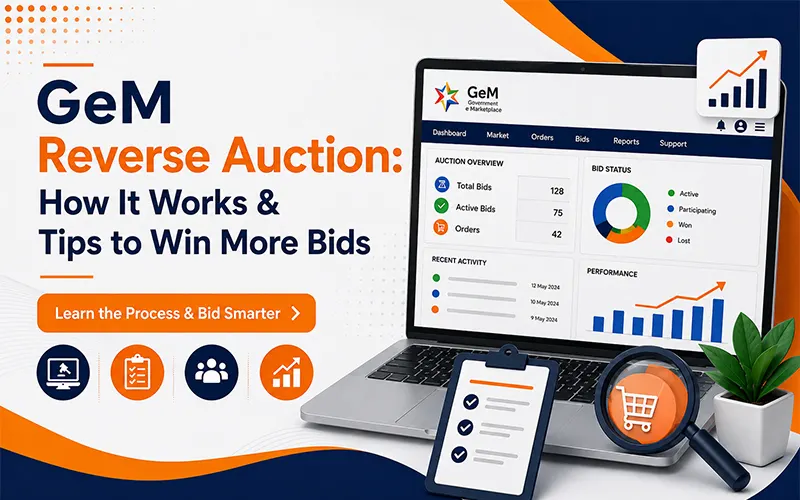
A GeM Reverse Auction is a transparent, real-time bidding process conducted on the Government e-Marketplace (GeM), where multiple eligible sellers compete for a government procurement opportunity by gradually reducing their prices within a predefined bidding period. The contract is generally awarded to the seller offering the lowest responsive bid while fully meeting the buyer’s technical specifications, quality standards, and eligibility requirements.
Unlike traditional tender bidding, where vendors submit a single sealed quotation and wait for the final evaluation, a GeM Reverse Auction allows participants to monitor the lowest bid during the auction and revise their pricing strategically until the bidding window closes. Understanding this process is essential for businesses looking to improve their competitiveness in government procurement. In this guide, you’ll learn how the GeM Reverse Auction process works step by step, along with practical strategies to bid intelligently, remain profitable, and increase your chances of winning more government orders.
What Is a GeM Reverse Auction?
In a traditional auction, multiple buyers compete to purchase an item, causing the price to increase with each bid. A GeM Reverse Auction follows the opposite approach. Here, multiple registered sellers compete for the same government procurement opportunity by continuously lowering their prices within a predefined bidding period. At the end of the auction, the contract is typically awarded to the seller who submits the lowest valid bid while fully complying with the buyer’s technical specifications, quality requirements, and eligibility criteria.
On the Government e-Marketplace (GeM), reverse auctions are widely used for high-value purchases, bulk procurement, and large-scale government tenders. This competitive bidding process enables government departments and Public Sector Undertakings (PSUs) to obtain the best value for money while ensuring fair competition among qualified and registered GeM sellers.
Step-by-Step GeM Reverse Auction Process

1. Buyer Publishes the Procurement Requirement
The government buyer initiates a GeM Reverse Auction by publishing detailed procurement requirements, including the product or service description, required quantity, technical specifications, delivery terms, and seller eligibility criteria.
2. Eligible Sellers Are Shortlisted
Only sellers who satisfy the prescribed technical qualifications, category requirements, compliance standards, and any pre-qualification conditions are permitted to participate in the reverse auction.
3. The Reverse Auction Begins
Once the auction window opens, eligible sellers submit their price bids within the specified time frame. Participants can generally view the current lowest bid without seeing the identity of the competing seller, allowing them to adjust their pricing strategy during the live auction.
4. Sellers Revise Their Bids in Real Time
As the bidding progresses, sellers have the opportunity to lower their prices based on the prevailing lowest bid. Many participants begin with a competitive initial quote and strategically reduce their bids throughout the auction to improve their chances of securing the contract while maintaining profitability.
5. Contract Award to the Lowest Responsive Bidder
After the auction closes, the buyer evaluates the final bids. The contract is typically awarded to the seller offering the lowest responsive bid that fully complies with all technical specifications, eligibility requirements, and procurement conditions, subject to final verification and approval by the purchasing authority.
How GeM Reverse Auctions Differ from Traditional Bidding
Unlike a standard GeM bid submission, where sellers submit a single sealed quotation before the bidding deadline, a GeM Reverse Auction is a live and interactive bidding process. Instead of waiting for the results after submitting one price, sellers can monitor the lowest available bid during the auction and strategically reduce their own prices in real time. This makes reverse auctions far more competitive, as your final bid is influenced not only by your pricing strategy and costs but also by the bidding behavior of other participating sellers throughout the auction period.
If you are new to the GeM Portal, it is advisable to first understand the fundamentals of the bidding process, including seller eligibility, document requirements, and bid submission procedures, before participating in a reverse auction. A solid understanding of standard GeM bidding will help you develop effective pricing strategies and improve your chances of winning competitive government procurement opportunities through reverse auctions.
Proven Tips to Win More GeM Reverse Auctions
Best Practices to Win More GeM Reverse Auctions
1. Determine Your Minimum Profitable Price Before the Auction
Before participating in a GeM Reverse Auction, calculate the lowest price you can offer while maintaining profitability. Consider product costs, logistics, taxes, compliance expenses, and your desired margin. Establishing your minimum acceptable price in advance helps you avoid making rushed decisions during live bidding.
2. Avoid Submitting Your Lowest Bid Too Early
Starting with your minimum price may reduce your flexibility during the auction and allow competitors to strategically outbid you. Instead, adopt a balanced bidding strategy that gives you room to adjust your prices as the competition evolves.
3. Stay Active During the Final Stage of the Auction
The most competitive bidding typically occurs in the closing minutes of a GeM Reverse Auction. Closely monitor the auction until it ends and be prepared to revise your bid whenever necessary to remain competitive without compromising profitability.
4. Complete All Documentation Before the Auction Begins
Ensure your GeM registration, seller profile, product catalogue, certifications, and supporting documents are accurate and up to date. Even the most competitive bid may be rejected if your documentation or eligibility requirements are incomplete.
5. Include Delivery and Logistics Costs in Your Pricing Strategy
When calculating your bid, account for transportation, packaging, delivery timelines, and all associated operational costs. A well-planned pricing strategy helps prevent financial losses after winning the contract.
6. Bid Selectively and Focus on Profitable Opportunities
Not every reverse auction is worth pursuing. Carefully assess the procurement requirements, estimated margins, and your operational capacity before participating. Winning a government contract should support sustainable business growth rather than forcing you to accept unprofitable pricing.
Final Thoughts
Success in a GeM Reverse Auction depends on much more than simply offering the lowest price. Sellers who prepare thoroughly, maintain complete compliance, understand the live bidding process, and follow a well-planned pricing strategy are far more likely to secure government contracts. Rather than making impulsive pricing decisions during the auction, establish your bidding limits in advance, evaluate your costs carefully, and participate with a clear strategy. By combining competitive pricing with proper planning and consistent compliance, you can improve your chances of winning more GeM tenders while protecting your profitability and building long-term success on the Government e-Marketplace (GeM).
You may also visit to: Understanding the GeM Seller Rating System
 Call Us
 Whatsapp